Anti-Aging Skincare After 30: What Actually Works (and What Doesn't)
Around age 30, your skin quietly changes. Collagen production drops by roughly 1 percent per year, cell turnover slows, and the first fine lines appear around the eyes and forehead. It is completely normal — but it is also the age when a smart skincare routine starts paying off for decades.
The problem is the noise. The anti-aging market is worth billions, and every product claims to turn back time. Most of it is marketing. Only a handful of ingredients have strong scientific evidence behind them. Here is what actually works after 30, and what you can safely skip.
Sunscreen: The Only Proven Anti-Aging Product
If you use just one anti-aging product, make it sunscreen. Dermatologists are unanimous: up to 80 percent of visible skin aging — wrinkles, dark spots, sagging — is caused by UV exposure, not by getting older. Studies following people over years confirm that daily sunscreen users show visibly less skin aging than those who skip it.
Use a broad-spectrum SPF 30 or higher every single morning, rain or shine, as the last step of your routine. This one habit alone prevents more aging than any expensive cream can reverse. Everything else in this article works best on skin that is already protected.
Retinoids: The Gold Standard
Retinoids — vitamin A derivatives including retinol and prescription tretinoin — are the most studied anti-aging ingredients in dermatology. Decades of clinical research show they boost collagen production, speed up cell turnover, fade dark spots, and soften fine lines. No over-the-counter ingredient comes close to their evidence base.
Start slowly: a low-strength retinol two to three nights a week, gradually building to nightly use as your skin adjusts. Expect some dryness or peeling in the first weeks — that is normal. Use retinoids only at night, since sunlight breaks them down, and always pair them with morning sunscreen. Pregnant women should avoid retinoids entirely and check with a doctor first.
Vitamin C and Antioxidants
Vitamin C is the best-supported daytime antioxidant. It protects skin from free-radical damage caused by sun and pollution, brightens dull skin, fades dark spots, and supports your skin's own collagen production. Research shows it also boosts the effectiveness of sunscreen when used underneath it.
Look for serums with L-ascorbic acid at 10 to 20 percent concentration, stored in dark, airtight bottles — vitamin C breaks down quickly in light and air, so a yellowed or orange serum has lost much of its power. Apply it in the morning after cleansing, before moisturizer and sunscreen.
Peptides and Hyaluronic Acid: Helpful Support Players
Peptides are short chains of amino acids that signal your skin to produce more collagen. The evidence is promising but not as strong as for retinoids — think of peptides as useful support, not a replacement. They are gentle, well-tolerated, and a good option for sensitive skin that cannot handle retinol.
Hyaluronic acid does not reverse aging, but it is excellent at what it does: attracting and holding water in the skin, which plumps fine lines and makes skin look smoother and fresher instantly. Use it as a hydrating serum under your moisturizer. It works for every skin type and pairs well with almost every other ingredient.
What Is Mostly Hype
Not every popular anti-aging claim holds up. Collagen creams sound logical, but collagen molecules are too large to penetrate the skin — they moisturize the surface at best. Collagen supplements have mixed evidence and work, if at all, from the inside, not through creams.
Expensive "stem cell" creams, gold-infused serums, and most jade rollers and gadgets have little to no clinical evidence for reversing aging. Facial exercises have weak evidence and may even deepen expression lines if overdone. A $200 cream is not automatically better than a $20 one — what matters is the active ingredient and its concentration, not the packaging or price.
The Simple Routine That Covers It All
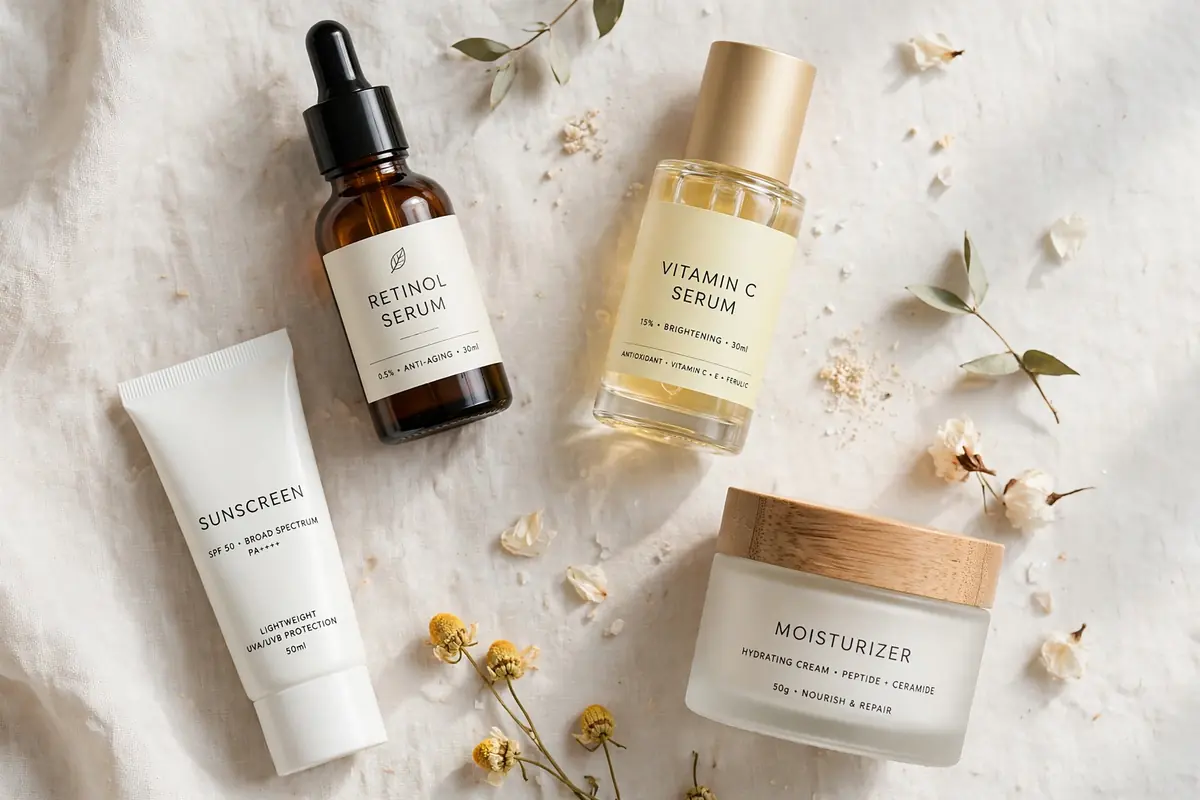
Here is an evidence-based routine for your 30s. Morning: gentle cleanser, vitamin C serum, moisturizer, and broad-spectrum SPF 30+. Evening: cleanser, retinoid (on alternate nights at first), and a richer moisturizer. Add a hydrating serum if your skin is dry, and a weekly gentle exfoliant — like lactic acid — if your skin looks dull.
That is the whole system: four to five products, used consistently. Most people see real improvement in texture and brightness within 8 to 12 weeks, with deeper changes over six months to a year.

Aging Well Is a Long Game
Anti-aging skincare after 30 is not about fighting your age or chasing perfection. It is about protecting what you have — sunscreen every day — and supporting your skin with the few ingredients proven to work: retinoids at night, vitamin C in the morning, and good hydration throughout.
Start simple, stay consistent, and ignore the hype. Your future self, ten years from now, will be glad you did.