Sunscreen Guide: Why SPF Matters Every Day
Most people treat sunscreen like a beach accessory — something for sunny holidays, not Tuesday mornings. But dermatologists agree on one thing above all others: daily sunscreen is the single most effective anti-aging and skin-protecting step you can take. Up to 80% of visible skin aging — wrinkles, dark spots, sagging — comes from sun exposure, not from getting older. And that damage happens on cloudy days, through windows, and during a ten-minute walk, not just at the beach.
Here is everything you need to know about SPF, stripped of the confusion.
How Sun Damage Actually Works
Sunlight damages skin through two types of ultraviolet rays. UVB rays are the "burning" rays: they hit the skin's surface, cause sunburn, and play a key role in skin cancer. UVA rays are the "aging" rays: they penetrate deeper, break down collagen and elastin, and cause wrinkles and dark spots over time. UVA passes through clouds and glass, which is why your skin ages even if you never burn.
SPF — Sun Protection Factor — measures protection against UVB only. SPF 30 blocks about 97% of UVB rays, SPF 50 about 98%. The jump from 30 to 50 is small, but the jump from no sunscreen to SPF 30 is enormous. For UVA protection, look for "broad spectrum" on the label, which means the product guards against both types. A sunscreen that is not broad spectrum is only doing half the job.
UV damage is cumulative: every unprotected exposure adds up over a lifetime. That is why daily use matters more than any single beach day — years of "just a quick walk" show up as aging in your forties and fifties.
Choosing the Right Sunscreen
With hundreds of options, choosing feels overwhelming. Start with the basics: broad spectrum, SPF 30 or higher, and a formula you will actually wear every day. The best sunscreen is the one you use — a perfect product sitting in a drawer protects nothing.
Chemical sunscreens absorb UV rays and convert them to heat. They tend to be lightweight, invisible, and easy under makeup.
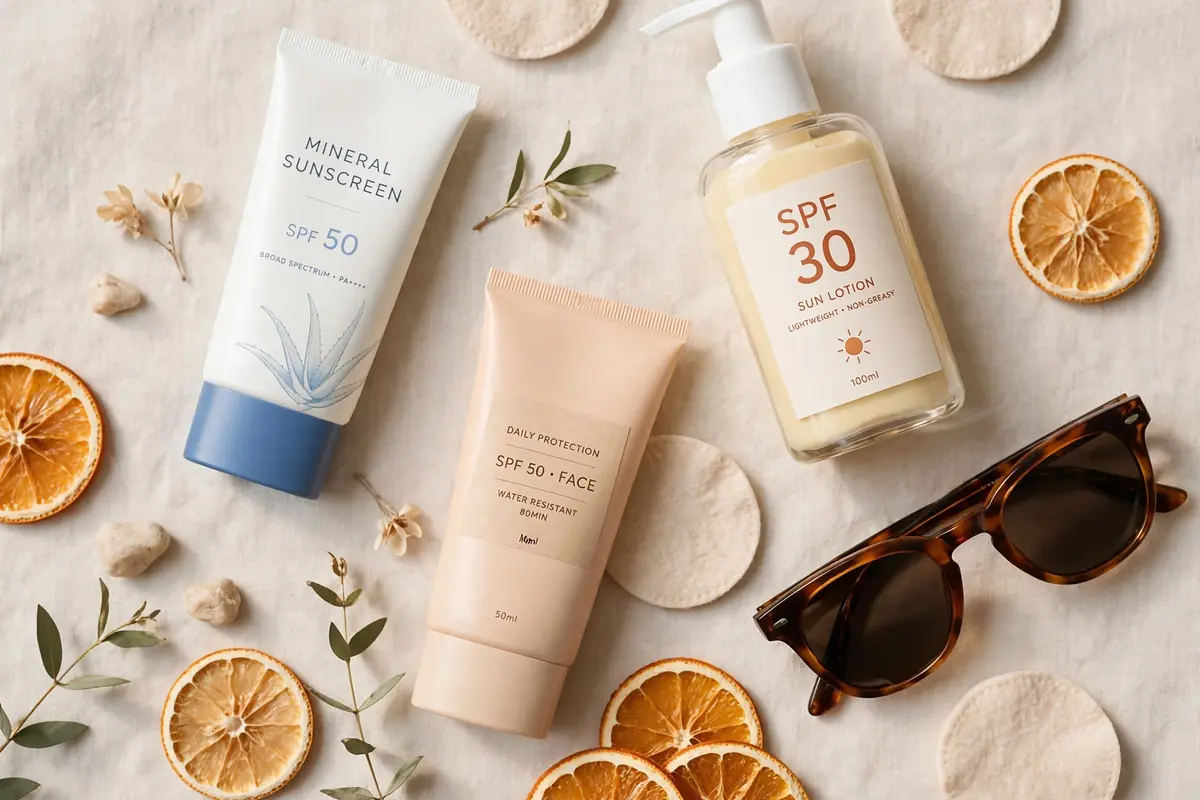
Mineral sunscreens use zinc oxide or titanium dioxide to block rays. They work immediately, suit sensitive skin, and are reef-safe, but can leave a white cast — tinted formulas solve this.
Texture matters as much as chemistry. Oily skin does well with gel or matte-finish sunscreens; dry skin benefits from creamy, hydrating formulas; combination skin often likes a lightweight lotion. If you wear makeup, a sunscreen that doubles as a primer saves a step and guarantees you actually apply it.
How to Apply It Correctly
Most people use far too little sunscreen — studies show the average person applies only a quarter to a half of the needed amount, which drops real protection dramatically. For your face alone, you need about a finger-length strip of product (two full finger lengths from base to tip), roughly a teaspoon. For the whole body, about a shot glass worth.
Apply sunscreen last in your morning routine, after moisturizer and before makeup. Do not forget ears, the back of the neck, tops of hands, and your hairline — and use an SPF 30 lip balm.
Reapplication is where most routines fail. Sunscreen wears off through sweat, touching your face, and natural breakdown — reapply every two hours outdoors, and after swimming or heavy sweating. On a normal indoor day, one thorough morning application plus a midday touch-up (a sunscreen powder or spray over makeup works well) covers you. And yes, you need it in winter too: snow reflects up to 80% of UV rays, and UVA passes through clouds year-round.
Common Sunscreen Myths
Myth one: "My moisturizer has SPF 15, so I am covered." SPF 15 applied thinly gives far less protection than a dedicated SPF 30 applied properly — use a separate sunscreen.
Myth two: "I have dark skin, so I don't need sunscreen." Melanin provides some natural protection — roughly equivalent to SPF 13 — but it does not prevent skin cancer, hyperpigmentation, or photoaging. Dark skin is actually more prone to dark marks after sun exposure, which makes sunscreen even more valuable for even tone.
Myth three: "Sunscreen causes vitamin D deficiency." You would need to apply sunscreen perfectly and thickly over your entire body, every day, to meaningfully reduce vitamin D — and studies show real-world use does not cause deficiency. A short walk with some skin exposed, or a supplement if your doctor recommends it, covers vitamin D easily.

Making It a Daily Habit
The easiest way to wear sunscreen daily is to attach it to something you already do: keep it next to your toothbrush, or choose a daytime moisturizer with SPF 30 built in. Once it becomes automatic — like brushing your teeth — you stop thinking about it, and your skin gets protected every single day without effort.
Sunscreen is not vanity. It is the one skincare step backed by the strongest evidence for preventing cancer, aging, and dark spots all at once. No serum, cream, or treatment can undo years of sun damage as effectively as simply preventing it. A bottle of SPF 30, used daily, is the best investment your skin will ever get.